They built the cart and forgot the wallet.
Swiggy and Zomato solved group ordering, right up to the payment. Then they stopped at the hardest part.
§ The gap hides at the finish line
Group ordering already exists on both Swiggy and Zomato. Share a link, everyone adds to one live cart from their own phone. The genuinely hard engineering, syncing eight carts in real time, is done and works.
Then, at checkout, it collapses to a single payer. One person pays the entire bill; everyone else settles up manually afterward. The product carries a group all the way to the counter, then hands one person the tab and walks away.
That's the pattern worth noticing. The feature didn't fail because the hard part was too hard. It shipped the hard part and skipped the awkward one.
§ The half that got left behind
Look at what happens after "Pay." None of it was designed. It's just the default nobody removed:
- 01The host pays the full amount.
- 02Someone does the per-item maths.
- 03The total lands in the group chat, usually as a screenshot.
- 04People send their share over UPI. Most of them. Eventually.
- 05The host chases whoever forgot.
Five steps of coordination, and the app owns none of them. It optimized getting food in; it ignored getting money sorted. For a duopoly where both apps carry the same restaurants and the same delivery promise, that unowned friction is exactly where differentiation is still cheap.
§ The demand is already visible
This isn't a hypothetical need. The workaround market proves it. Apps like Splitkaro exist largely to import your Swiggy/Zomato order history, split it item-wise, and collect over UPI. Hundreds of thousands of downloads.
Read that as revealed preference. Users will leave the food app, install a second app, sign in with their food-app login, re-import an order they just placed, and tag every dish to a name, all to avoid being the one stuck chasing money. When people build that much effort into a workaround, the underlying job is real and unserved.
The honest counterpoint: UPI is instant and free, and plenty of people find "just pay me back" good enough. Fair. But "good enough" is the bar a native fix has to clear, and the size of the workaround market says a meaningful slice of users don't think it's good enough at all.
Today · The dead-end
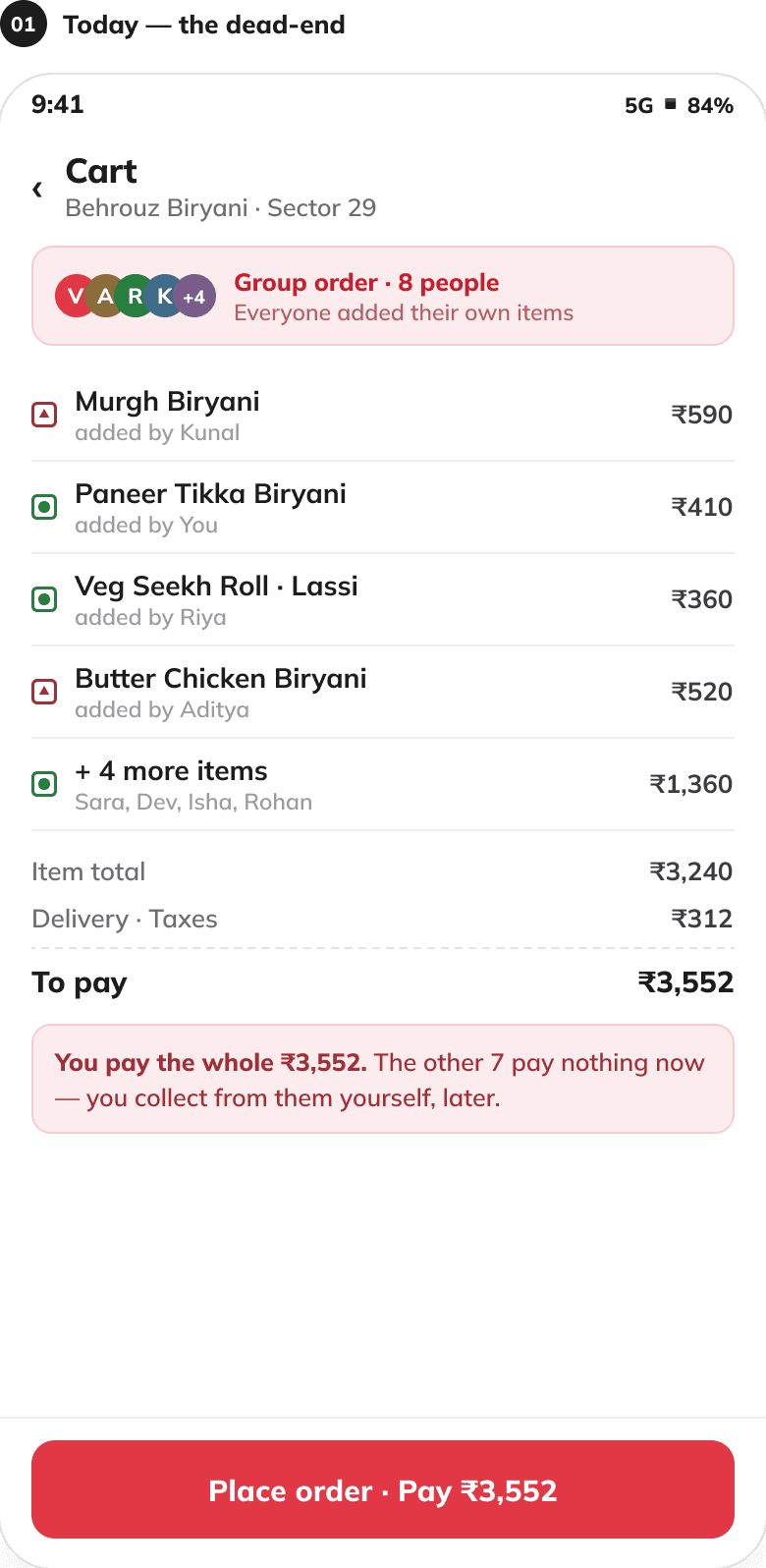
The full bill sits on one name; everyone else pays ₹0 now.
Choose how to split
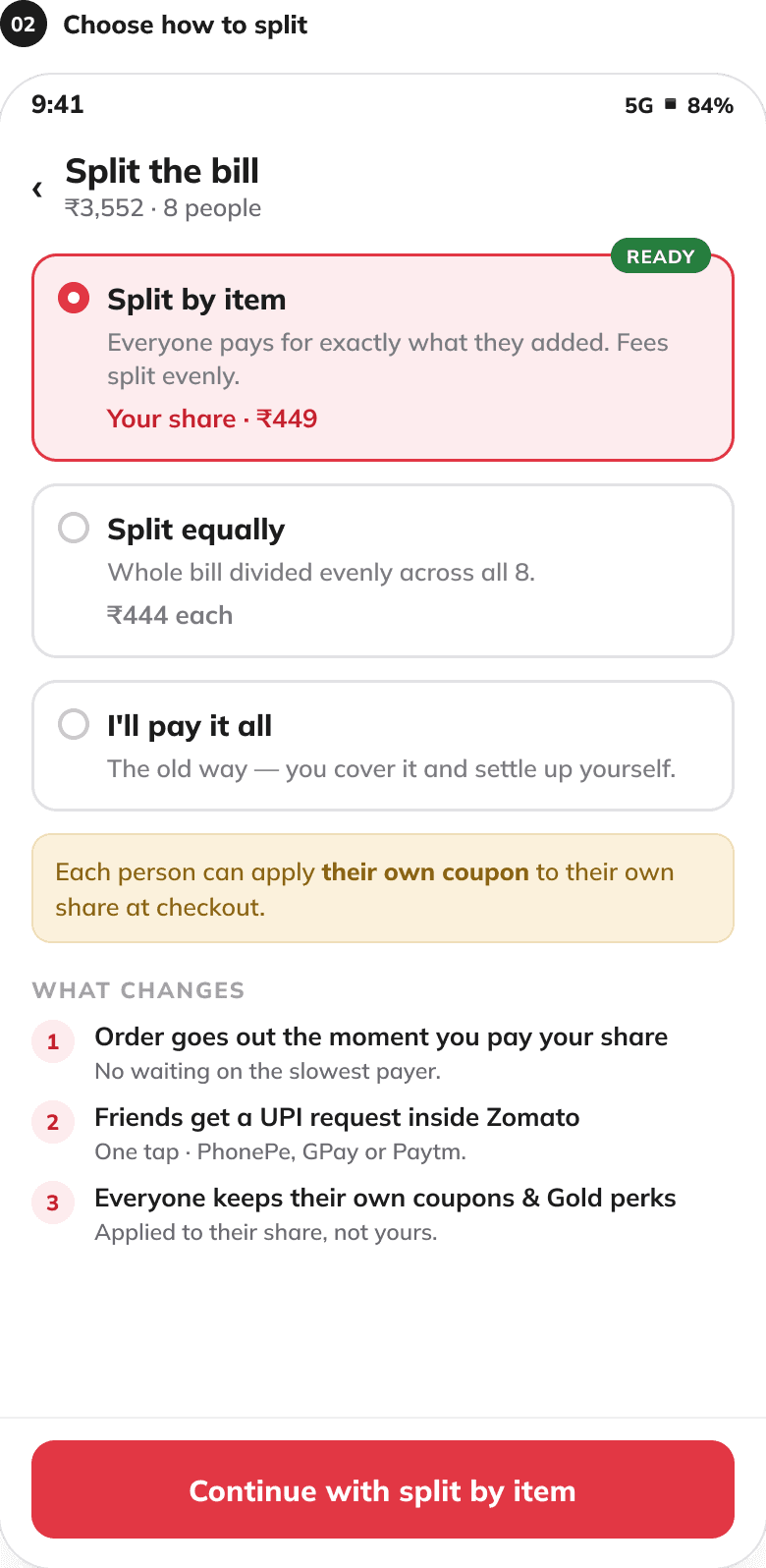
Split by item, split equally, or pay it all. Each person keeps their own coupon.
§ Design the settlement, not just the split
The fix is small in scope. Let each person pay their own share at checkout over UPI, and apply their own coupon to their own portion. The host stops being everyone's creditor.
The real design decision is sequencing, and it's where most naive versions break. If the order can't be placed until all eight have paid, you've made dinner hostage to the slowest person in the group. That's a completion-rate risk solo ordering never had. So don't gate the order on the split.
Everyone's share, ready to send
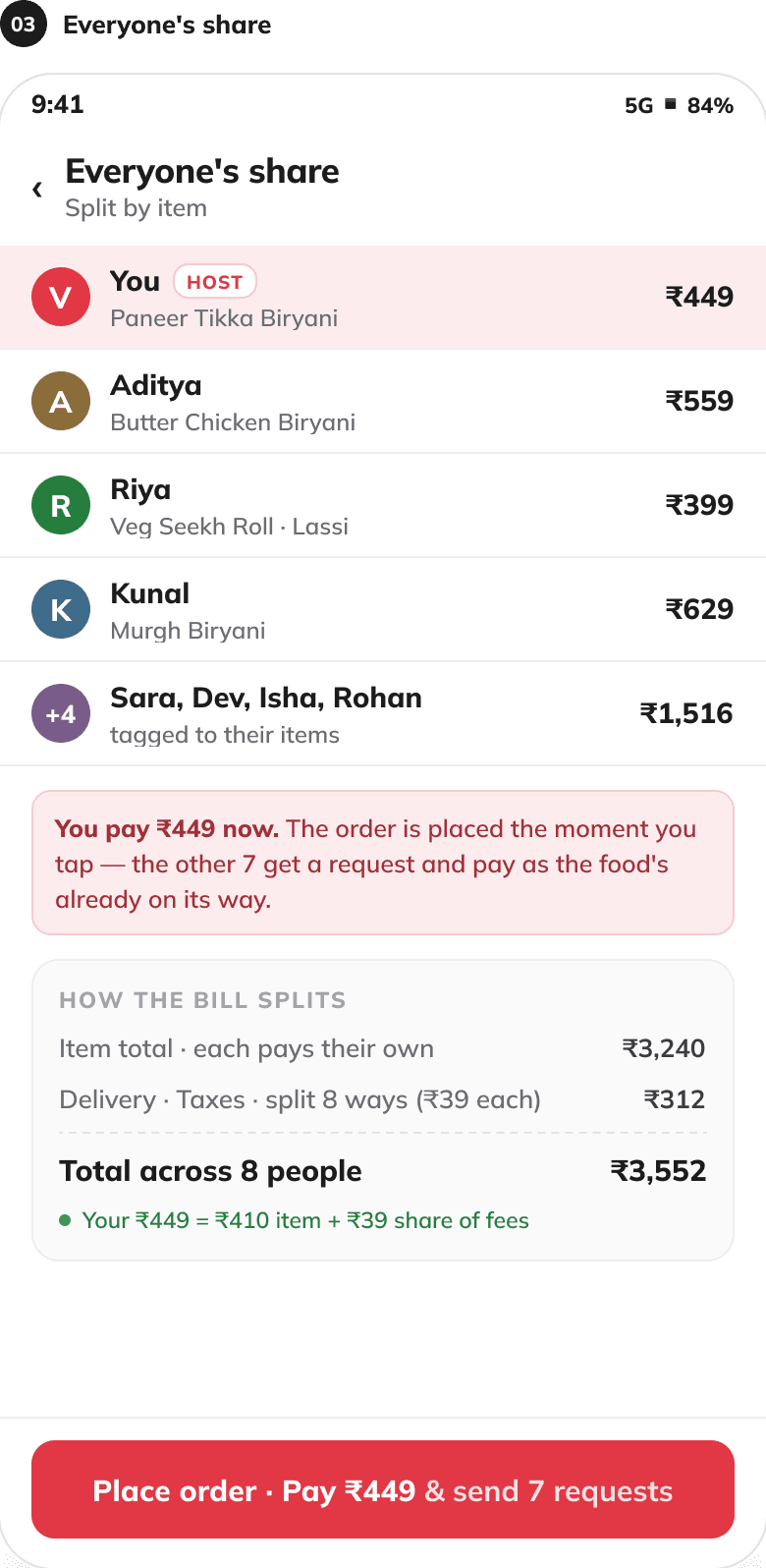
Host pays ₹449, order goes out, the other seven get UPI requests in parallel.
Order placed, collection running
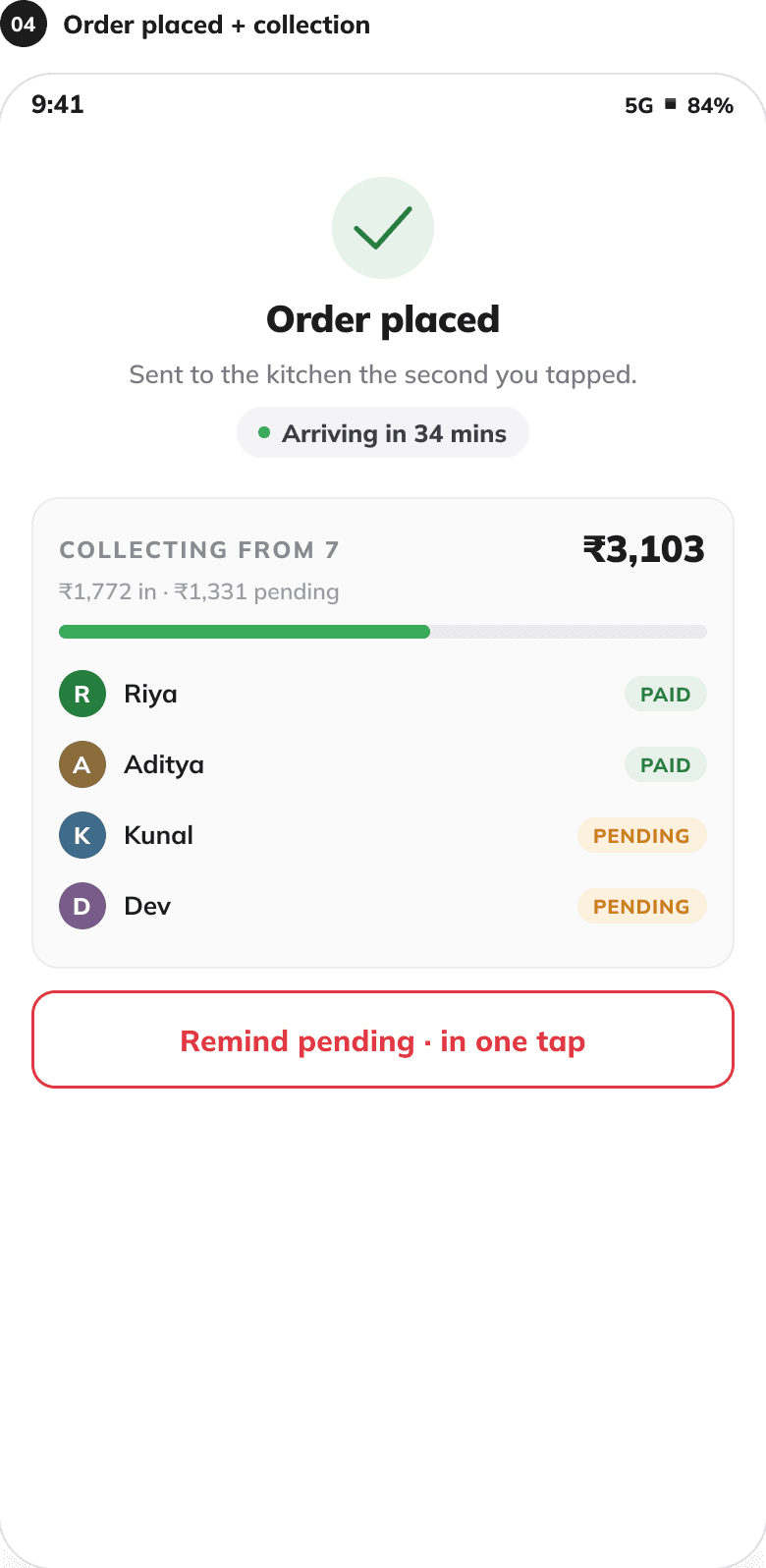
₹1,772 in, ₹1,331 pending. Nudge the stragglers in one tap.
Host pays upfront in one tap. The order ships immediately. Each person's share is requested in parallel while the food is already cooking. Split becomes a collection after, not a gate before. The debt gets settled; the order is never held up.
Collection, not gate.
That single reframe is what turns a risky feature into a safe one.
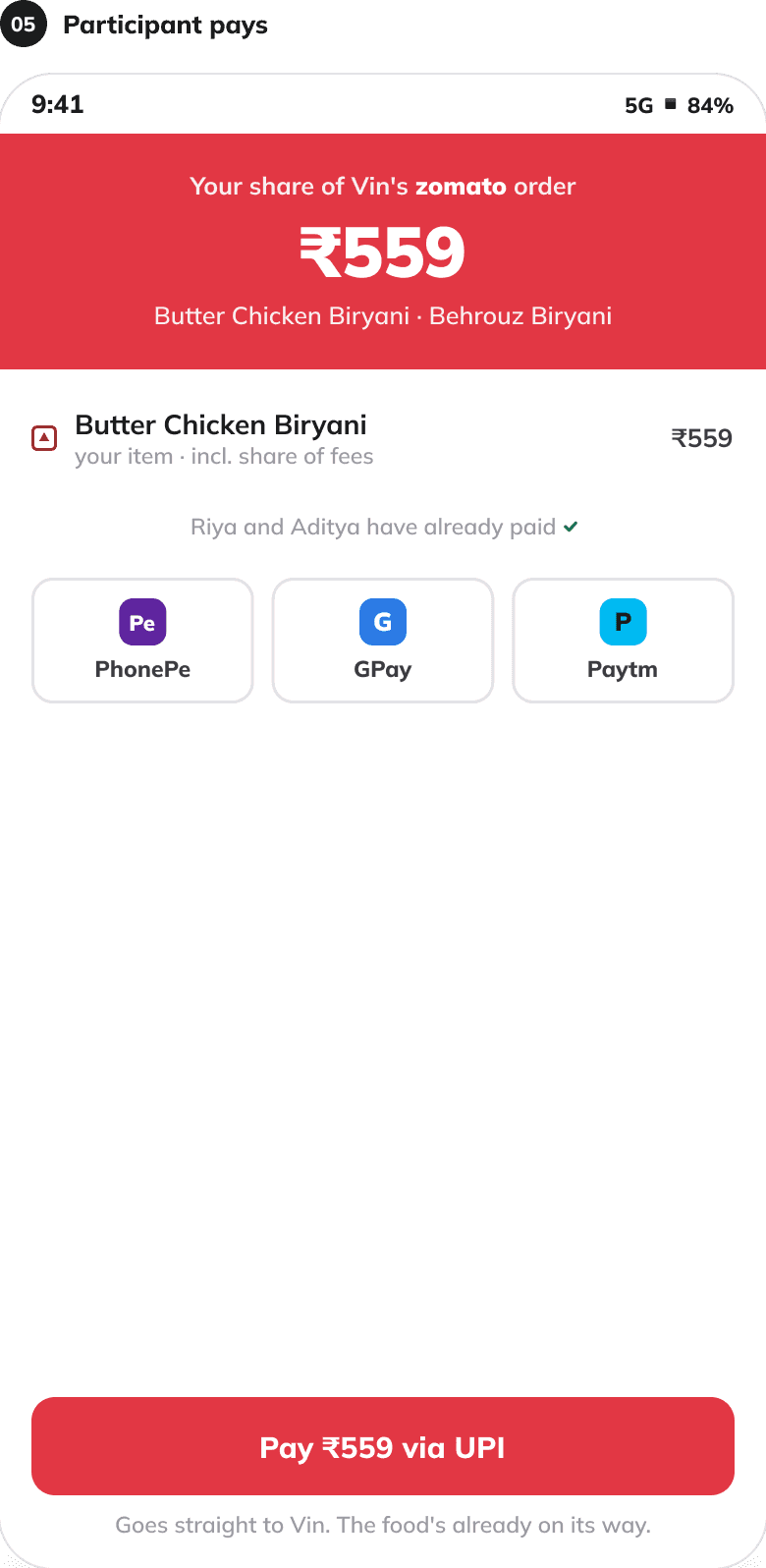
The request lands inside Zomato. One tap via PhonePe, GPay or Paytm. The food's already on its way.
§ It's not even new, it's next door
Zomato has already built this. Just in the wrong app. District, its going-out product, launched Splitpay in 2026: everyone at a restaurant table pays their own share in-app, no screenshots, no next-day chasing. Same parent company, same payment problem, already solved. Just for dine-in.
The capability is in the building. It just hasn't been brought to the delivery app, where the group-order friction is loudest.
§ Takeaway
The most useful features often aren't missing. They're finished at 90%, stopped right before the part that was uncomfortable to build. Group ordering ships the cart and forgets the wallet.
Whoever closes the last 10% owns the group occasion.
In a market where almost nothing else is left to differentiate on, that last 10% is the differentiation.
#ProductManagement #Payments #ConsumerTech
Get new posts in your inbox.
New post every week. No spam, unsubscribe anytime.